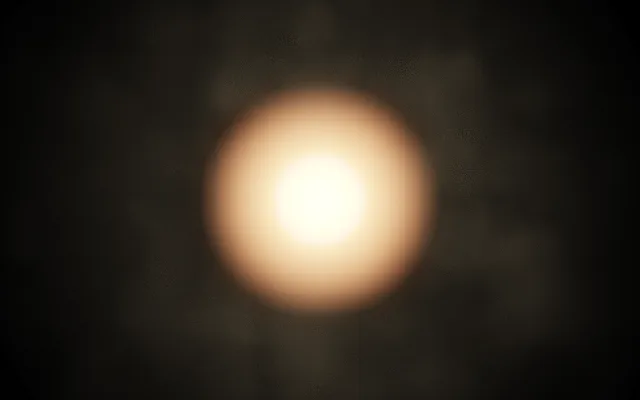
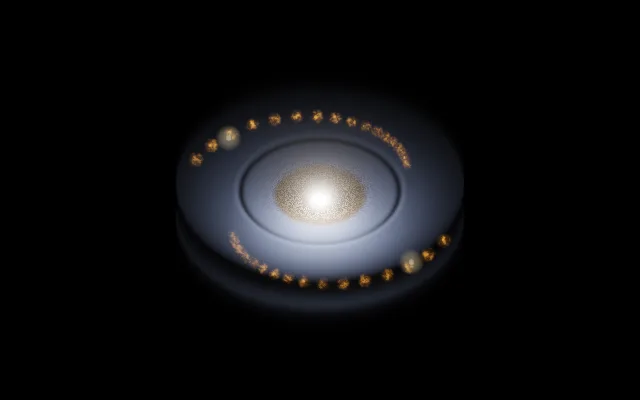
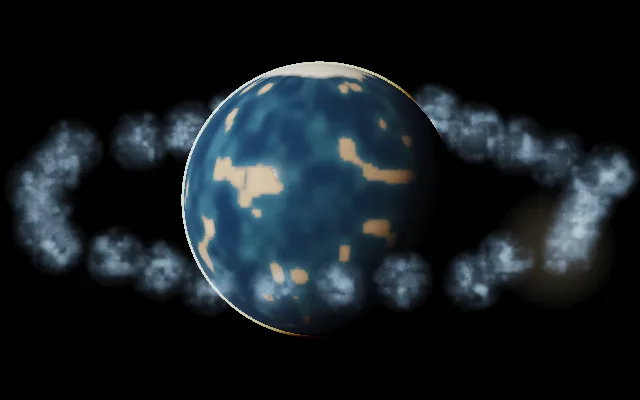
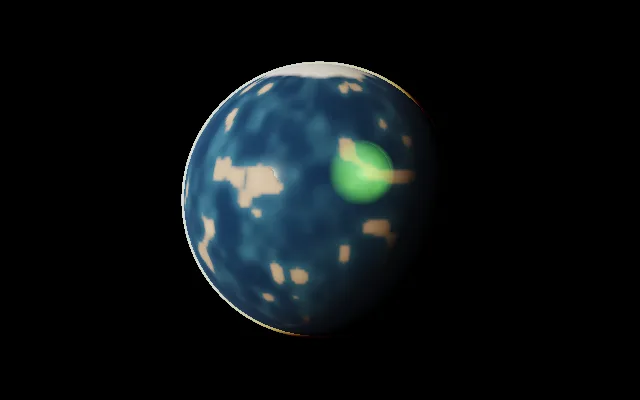
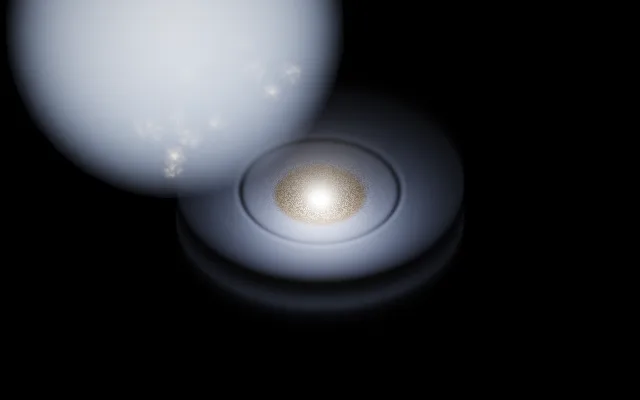
Broken warm arcs cross diagonal dust clouds around a partly obscured central star: the moment a star ignites.
A solar system from the first speck of dust. For real.

From a cloud of dust to life.

Begin with dust, drifting in the dark. Watch it gather into a star and a family of worlds, and find where life takes hold. Then shape lifeforms of your own, and see where they go next.

Real astrophysics, simulatedEvery world is differentSee how life... happens.
Play

Free, in your browser

4.5 bnyears of history baked into your world
75pieces built
9rungs from first cells to a mind
8eras from microbes to space stations, on the world you forged
01

Not a sandbox. A sim you can trust.

Begin with a cloud of dust and watch it become a solar system, then find where life takes hold and shape lifeforms of your own. Under the hood is a model of how stars, planets, climates and biospheres actually work, lifted straight from the papers. You set the conditions. The physics takes it from there and tells you exactly what it did. And this is only where it starts.

You don’t get outcomes. You get consequences.

Every move is physical: more mass here, a shove against the spin, a rock from outside, carbon buried in a rift. What happens next gets computed, never scripted. Same move, different seed, different system.

The clock stops when it’s your turn.

At every turning point the game freezes, frames the thing in question, and shows you what each choice really does before you commit. Let it be is always free, and it tells you what the sim thinks happens if you keep your hands off.

What you forge, you keep.

Finish a system and it gets sealed into a seed: the worlds, their histories, the lineage you shaped. Replay it. Share it. Everything that happened on the way is tagged Here, Elsewhere, Theory or Imagined, so when something wild goes down you can pull the paper.

Four stages, one continuous shot

Every frame here is the game's own render.

  1. Star

    The first light
    The first light
  2. Planets

    Spiral arms
    Spiral arms
  3. Worlds

    Rings from a moon
    Rings from a moon
  4. Life

    First life
    First life
02

Five loops. No cuts.

One camera, start to finish. The cloud you stir turns into the disk you shape, which turns into the system you watch tear itself apart, which turns into the worlds you keep alive, which turns into the tree you climb, which turns into the lifeforms you shape. The science each loop runs on sits right under it.

Star0 → 500,000 years

Light a star. Decide what kind.

The core collapses only when gravity beats what holds it up. Your pushes, spins and squeezes decide whether, when, and into what.
from the game's Why? for Turn 1

What it runs on

A core only collapses when gravity wins. The game reads a Jeans mass, a virial ratio and a mass-to-flux ratio off your cloud. Too much spin and it splits into two stars. Too little mass and you get a brown dwarf that fades out.
Late infall can tilt or reverse a disk. Gas keeps falling onto young disks; when it carries the other spin, the outer disk ends up misaligned or counter-rotating.[1]
Carbon-rich clouds make dry, diamond-bearing worlds. Above a carbon-to-oxygen ratio of about 0.8, the oxygen locks in CO and there is little water; Mercury is modelled with a diamond layer under its mantle.[2]
Planets→ 150 million years

Decide where the rock goes. Then watch it collide.

Turn 10 · Planets852,000 years

Ice is forming in the disk

Beyond 4.8 AU it is cold enough for ice, and solids are piling up at that line. The first big planet usually starts here.

Thicken the ice line−2⚡
Seed outer ice−2⚡
Let it befree
4.3–6.0 AU: solids ×3, gas +60% right away.
Your systemChoose · −2⚡ ⏩

What it runs on

Planets grow where the pebbles jam up. The rings and gaps in ALMA images are pressure bumps trapping drifting dust. The game’s disk runs on the same papers: an α-disk, two-population dust, pebble accretion.[3]
An early giant walls off the inner system. The two isotopic families of meteorites exist because an early Jupiter core blocked pebbles; our inner planets came out small and dry.[4]
The giants went unstable early. New dating puts it 60–100 million years after formation, not 600. The game samples it there.[5]
Stars eat planets. We’ve watched it happen. A Sun-like star flared a thousandfold as a Jupiter spiralled in. JWST showed the planet fell; the star didn’t swell.[6]
Worlds→ 4.5 billion years

Keep a world alive while its star turns up the heat.

Heat flow, outgassing, weathering, escape, impacts, a magnetic field. The thermostat that keeps water liquid can break in either direction.
the Worlds stage, in one line

What it runs on

A planet runs its own thermostat, until it can’t. The carbonate–silicate cycle pulls CO₂ down as the star brightens. A stagnant lid weakens it, and a world can still pass the gate under one.[7]
Too much water is a trap. Beyond a few tens of oceans, high-pressure ice seals the seafloor; no land, no weathering, no thermostat.[8]
Earth may have worn a ring. Ordovician craters cluster at the palaeo-equator, read as the shadow of a ring from a broken asteroid; its shade may have helped bring on an ice age.[9]
One volcanic province ended the Permian. CO₂ rose several-fold in tens of thousands of years and the seas went anoxic; other provinces cooled the world as their fresh rock weathered.[10]
Lifefirst cells → a mind

Open the windows. Life walks through when it’s ready.

The steps to intelligence were not luck. Each became possible once the planet permitted it: oxygen, nutrients, land, a climate that varies.
the principle behind the windows

What it runs on

Intelligence showed up on schedule, not by luck. A 2025 reassessment of the hard-steps model finds each step gated by the planet reaching a permissive state, with the windows opening in order.[11]
Life was fast and early. The last universal common ancestor is now dated to about 4.2 billion years ago, already a complex cell with an immune system.[12]
Complex cells followed the oxygen. Dated gene duplications place the mitochondrial merger shortly after the Great Oxidation; animals needed only a modest further rise.[13]
Fire has a window. Wildfire will not hold below about 16 % oxygen and runs away above about 30 %; a mind that wants metals needs to live inside that band, on land.[14]
Four lifeforms from four worlds
VerolHerean Earth-like world
Furred · Warm-blooded · Many-voiced
A lifeform on land, on a 1.1 g world under a 5,800 K star, furred and warm-blooded, that can make fire.
Can fire, metals, agriculture, architecture, writing, sailing, astronomy
Cannot flight
Why?
Furred a climate that swings selects for insulation (Bergmann and Allen)
Warm-blooded a variable climate favours endothermy
Many-voiced predation pressure favours large groups, and large groups favour big brains
✓ fire land, hands, oxygen in the band
✓ metals needs fire
✓ agriculture land, seasons, hands
✓ architecture can build
✓ writing a manipulator and a medium
✓ sailing a coast and timber
× flight gravity 1.1 g and a heavy body
✓ astronomy a sky
SaruHerea heavy world of a red star
Heavy-set · Infrared-eyed · Clannish
A lifeform on land, on a 1.6 g world under a 3,400 K star, heavy-set and infrared-eyed, that can make fire.
Can fire, metals, agriculture, architecture, writing, sailing, astronomy
Cannot flight
Why?
Heavy-set gravity is 1.6× ours: strength grows with cross-section, weight with volume
Infrared-eyed a 3,400 K star is brightest in the near-infrared; its plants are black
Clannish moderate predation: mid-sized groups
✓ fire land, hands, oxygen in the band
✓ metals needs fire
✓ agriculture land, seasons, hands
✓ architecture can build
✓ writing a manipulator and a medium
✓ sailing a coast and timber
× flight gravity 1.6 g and a heavy body
✓ astronomy a sky
RinuvanHerea drowned world
Short-lived · Many-voiced · Song-speaking
A lifeform in the sea, on a 0.9 g world under a 5,600 K star, short-lived and many-voiced, that will never make fire.
Can astronomy
Cannot fire, metals, agriculture, architecture, writing, sailing, flight
Why?
Short-lived heavy predation at sea: grow smart and die young; generations do not overlap
Many-voiced predation pressure favours large groups, and large groups favour big brains
Song-speaking water carries sound far: voice and echolocation
× fire no fire under water
× metals needs fire
× agriculture no fields at sea or in the dark
× architecture soft bodies, no durable stone work
× writing no manipulator
× sailing no need, or no shore
× flight gravity 0.9 g and a heavy body
✓ astronomy a sky
TokanasTheorya world thrown out, alive under ice
Slow-breathing · Blind · Pale
A lifeform under the ice, on a 1.0 g world under a 5,200 K star, slow-breathing and blind, that will never make fire.
Can architecture
Cannot fire, metals, agriculture, writing, sailing, flight, astronomy
Why?
Slow-breathing oxygen at 0%: large breathing surfaces, a slower pace of life
Blind no light reaches the ocean under the ice; touch and chemistry carry the senses
Pale no light under the ice: no pigment, no eyes
× fire no fire under the ice
× metals needs fire
× agriculture no fields at sea or in the dark
✓ architecture can build
× writing no durable medium in the dark
× sailing no need, or no shore
× flight gravity 1.0 g and a heavy body
× astronomy no sky until the ice breaks
Lifeformsfrom your world’s history

Shape the lifeforms you’ve grown.

When life takes hold, it comes as more than one lineage, and you shape them. Each takes its body, senses, society and limits straight from the world you made and what it lived through. No dice. Every trait has a reason you can read. The lineages you don’t shape are still out there, living as the other peoples of that world.

What it runs on

Evolution keeps finding the same answers. Camera eyes showed up separately in vertebrates and cephalopods. Intelligence showed up in primates, whales, crows and octopuses on different brain hardware. The environment does the shaping.[15]
Tech needs land. A mind in the sea can be brilliant and still never smelt a metal. A Bayesian take on land versus ocean makes the case, and the game’s constraints follow it.[16]
Plants under a red star are black. Photosynthesis shifts with the star's spectrum, and so does vision; the game's lineages see where their star is brightest.[17]
03

The deck

Every card is something that actually happened, or could. Here is our own solar system. Elsewhere was spotted around another star. Theory is allowed by physics and not found yet. Imagined is hard sci-fi that plays by the rules, Life stage only. The game never passes off a maybe as a fact. Each card has its own link.

StarElsewhere

Pour it in backwards

Late infall against the spin. Gas falls in, the star brightens, the outer disk tilts or turns the other way.

source
StarTheory

Seed with soot

A carbon-rich cloud. Oxygen locks in CO, oceans never form, and a diamond layer forms at the core. Beautiful, and lifeless.

source
StarHere

Truncate the disk

A close pass in the birth cluster cuts the disk at 50 AU and leaves a detached belt that feeds comets later.

StarHere

Compress the core

The cloud collapses only when gravity beats what holds it up. Too much spin and it splits in two.

PlanetsElsewhere

Raise a wall

A pressure bump traps drifting pebbles. The ring you see in ALMA images is where the first planet forms.

source
PlanetsHere

Build the wall early

An early Jupiter core blocks the pebble flux. The inner worlds come out small and dry, as ours did.

source
PlanetsElsewhere

Spin a whirl

A vortex gathers dust into a crescent and one large body forms fast on one side of the disk.

PlanetsElsewhere

Tilt the far one

A distant companion pumps a giant’s eccentricity until tides capture it on a tight orbit, sometimes backwards.

source
PlanetsElsewhere

Let it fall

Drag a planet into the star. A thousandfold flash for days, a dust shell, and the only action that pays Power back.

source
PlanetsHere

Break the moon

A moon inside the Roche line becomes rings. Saturn’s may be the remains of a moon lost 100 million years ago.

source
PlanetsHere

Catch one backwards

A retrograde captured moon wrecks the original moons and, over billions of years, spirals toward rings.

PlanetsHere

Knock the giant over

A two-Earth-mass impact tips an ice giant on its side. Its moons form in the new plane and get decades-long nights.

PlanetsTheory

Hide a giant far out

A far planet shepherds the outer belt and times comet showers. We are still looking for ours.

WorldsHere

Give the world a ring

A grazing asteroid breaks into an equatorial ring. Its shade cools the tropics for tens of millions of years, then rains down.

source
WorldsHere

Crack the crust

A flood-basalt province. CO₂ up, ten degrees warmer, the seas go anoxic. Then the fresh rock weathers and cools the world.

source
WorldsHere

Roll the world

True polar wander moves continents to the equator, where they weather faster. One route into a snowball.

WorldsTheory

Drown it

Beyond a few tens of oceans, high-pressure ice seals the seafloor. No land, no weathering, no thermostat.

source
WorldsHere

Spin it backwards

A retrograde day of hundreds of ours. The dynamo starves and the air goes to the wind, as on Venus.

WorldsElsewhere

The sky flashes

A gamma-ray burst strips half the ozone for years. The rarest card in the deck, and why Shelter matters.

WorldsHere

Gather the lands

A supercontinent dries its interior and warms the world; its breakup rifts, weathers and cools it.

LifeTheory

Carry the spark

Rocks blasted off a living world seed its neighbour. A second way for twin worlds to live, and a way back from sterilisation.

LifeHere

Bury the carbon

Organic carbon buried in rifts is the source of free oxygen. The Great Oxidation as something you can hurry, through geology.

source
LifeHere

Raise the mountains

Collide two plates. Phosphorus flows to the sea and the animals’ window opens sooner.

LifeHere

Green the land

The first forests multiply weathering and push oxygen into the band where fire is possible.

source
LifeHere

Cull the giants

An extinction below sterilising strength kills the largest bodies first and opens niches for the survivors.

LifeHere

Vary the climate

Ice-age cycles select for flexible minds. Arrange a continent on a pole and the brain window opens.

LifeTheory

Open the ice

A dark lineage under ice can reach animals on chemical energy, and no further without light. Crack the shell.

LifeTheory

The world that was thrown out still lives

An ejected, water-rich world keeps a dark ocean on its own heat. The saddest card gets a second ending.

LifeImagined

Floaters in the clouds

Life in a giant’s atmosphere: gas-bag grazers, hunters, sinkers. A thought experiment made a branch, with no ground and no fire.

LifeImagined

A colder chemistry

Ammonia or methane as the solvent on a cold world. Slow metabolism, long lives, a mind that thinks in centuries.

LifeImagined

The thinking forest

A sessile lineage that computes through a shared root network. It cannot move, build or burn; it can remember for ages.

LifeImagined

Two as one

An obligate symbiosis: one body for hands, another for thought. Neither gets there alone.

LifeImagined

Intelligence without an inside

A lineage that solves and builds without anything it is like to be it. The game can only show its works.

33 of 33 cards · 16 here · 6 elsewhere · 6 theory · 5 imagined

04

The tree of windows

Nine rungs from first cells to a mind. Each one opens only when the world has what it takes. The gates are physics the sim already runs. The waits inside an open window are game design, and the game says so.

R0First lifeneeds: a pond, a vent, or the dark under ice4.2 billion years ago hereR1Light-eatersneeds: sunlight on a surface ocean, iron, nutrients3.0–2.7 GaR2The air turnsneeds: the oxygen sinks saturate2.4 GaR3Complex cellsneeds: oxygen above a floor, a warm stable oceanafter the Great OxidationR4Sex and sizeneeds: phosphorus, oxygen held1.0 Ga · the long calm beforeR5Animalsneeds: oxygen above the animal floor, flooded shelves0.64–0.54 Ga · oxygen 0.4%: needs about 1%R6Onto the landneeds: an ozone shield, land, wet–dry cycles470–370 MaR7Big brainsneeds: by branch: land, sea, air, or a colonythe last few MyrR8A mind wakesneeds: fire needs land, hands, oxygen 16–30%0.3 Mascar: snowball, 720 Ma · surface lineages −1 rung, vents untouchedlandseaaircolonyintelligence arose more than once here; the tree branches
Window openWindow closingShut, with the reasonA reset: cause and date
Here

The air turns

Oxygen rises once the planet's sinks saturate. Methane collapses, the world can freeze, ozone forms, the anaerobes die back. One event, four consequences, none of them chosen.

Here

The long calm

A billion years of low oxygen and scarce phosphorus. The stall card explains why nothing is happening and offers the nutrient levers.

Here

Resets are graded

Only a boiled or melted ocean empties the tree. A snowball, an anoxic sea or a UV spike drops rungs by a rule and leaves a scar with its cause and date.

05

Shape a lifeform

Push the planet around and watch the lifeform change. Gravity sets the body. The star sets the eyes. Oxygen sets what it can burn. Lifespan sets whether it can teach. Same inputs, same creature, every time.

Gravity1.00 g
Star temperature5,800 K
Oxygen in the air21%
Climate variabilitymedium
Predation pressuremedium
Branch
LusiraHereyours
Handy · Keen-eyed · Clannish
A lifeform on land, on a 1.0 g world under a 5,800 K star, handy and keen-eyed, that can make fire.
Can fire, metals, agriculture, architecture, writing, sailing, astronomy
Cannot flight
Why?
Handy grasping limbs from a climbing ancestry
Keen-eyed a sun-like star: vision centred on visible light
Clannish moderate predation: mid-sized groups
✓ fire land, hands, oxygen in the band
✓ metals needs fire
✓ agriculture land, seasons, hands
✓ architecture can build
✓ writing a manipulator and a medium
✓ sailing a coast and timber
× flight gravity 1.0 g and a heavy body
✓ astronomy a sky
Imagined

Beyond the familiar

In the Life stage the game may borrow from hard science fiction, on one condition: the simulation's physics still gates it. A floater needs a thick atmosphere and no ground. A cold chemistry gives slow life. A thinking forest remembers and cannot move.

Imagined

Different kinds of life

A colony that thinks with numbers. Two species that live as one. A lineage that builds without any inner life. Each is a branch with its own window, its own constraints, and a trophy that says “imagined”.

Theory

What stays fixed

Chemistry needs a solvent, an energy gradient and a way to copy. Intelligence needs time, a stable niche and something to think about. Fire needs oxygen, fuel and land. The imagined branches cannot break these.

06

After the forge: shape life on it

Once a world is sealed, you shape a mortal lineage on it, and you have a creature: a steward that automates the work and keeps things running while you're away. The planet keeps doing what the forge taught it to do, and that is where your trouble comes from.

The sim is the storyteller

Eruptions, impacts, climate swings and tectonic shifts come from the physics of the system you forged, not from a random event table. Rates and sizes come from the planet's own numbers. Timing is seeded in the kernel.

The loop, up close

Gather, build, tend, direct the creature, react to what the planet does. Grow a settlement or a biome through a crisis the sim produced. Climb the eras. Reach orbit. Open travel across the galaxy.

Always on, with rules

Your system keeps simulating while you're offline. That is real risk, so there are explicit protections: the steward acts within limits you set, decay has caps, and a bad night never drops you below a floor.

Eight eras, microbes to space stations · 100+ hours to the top
  1. Era 1 · ships firstMicrobes
  2. Era 2 · ships firstMulticellular
  3. Era 3Land
  4. Era 4Settlement
  5. Era 5Industry
  6. Era 6Flight
  7. Era 7Orbit
  8. Era 8Stations

Eras 1–2 ship first and are microbial and plant-only. Space-era tech is what opens the galaxy: visiting, trade, carrying life between systems, arks.

Phase 3

Your star in a shared galaxy

Every player's forged system is a star in a seasonal galaxy sector. Early in the season everyone is alone in their own system. Spectate anyone from day one. Trade, carry life across and migrate once your tech can reach.

Phase 3

Seasons, and The Divide

Six-month seasons, each shipping one mechanic, one tech branch, one cosmetic set. At season's end your home star moves to The Divide, a permanent galaxy that never resets and never deletes. Forever means forever.

Phases 1–4

On Steam first, then Xbox

Steam Early Access first. Xbox is the first console, with cross-play and cross-progression. An Unreal 5 client on a pure .NET server that holds all the truth; the kernel is bit-identical on every platform.

07

What you can buy, and what you never can

Money buys collection, convenience, cosmetics and hosting. It never buys power, territory, odds or the in-game currency. Prices below are the plan's benchmarks, still open.

Seed Slotcapacity to hold one forged system; everyone gets one free · permanent across seasons$4.99, 3 for $11.99
Home Starthe one system per account per season that joins the galaxy and economy · content resets each season; migrates to The Divideincluded
Forged World (Forever Snapshot)permanent, non-consumable, private, single-player artifact re-simulates bit-for-bit; shareable by Forge Code (viewing free, owning paid) · forever$2.99–$6.99 by rarity class (deterministic, previewed)
Cosmeticscreature, action effects, planet rings/auroras, UI themes · forever; account-bound; non-tradable$1.99–$14.99
Supporter Packscosmetic set + slots + codex credit · forever$20 / $40 / $100
Hosted Worldpersistent private/shared world hosted by us · subscription$6–$15/mo by player cap
Divide Upkeepkeeps a migrated system simulating in The Divide; lapse freezes read-only, never deletes; first system has a grace period · subscription per system$3–$4/mo

Never

  • No purchasable, real-money-linked or price-obscuring currency. Credits are earned only. Real-money prices only.
  • Home-star seeds are server-derived; no two accounts forge the same system. Only sealed Forged Worlds can be landed on.
  • No randomized paid outcomes, no loot boxes. Rarity is deterministic and shown before purchase ("preview, then seal").
  • No pay-to-win via territory: one home star per account per season; extra slots never add galaxy presence; a re-forge after extinction reuses the same slot.
  • Rarity is prestige with handicap scoring: hostile systems score higher; rarity never confers an economic edge.
  • Cosmetics are account-bound and non-tradable.
  • Self-hosted servers run private galaxies only.

A season

  • Length: 6 months. A season ships one mechanic, one tech branch, one cosmetic set and balance changes.
  • Start: new sector; every account's slots return empty; home star chosen (or re-forged).
  • During: play, trade, leaderboards; mid-season joiners start behind .
  • End: rollover saga freezes each home star and migrates it to The Divide, a permanent, playable, tradable galaxy with its own economy and its own wallets; the season wallet migrates exactly once into the Divide wallet and the next season starts at zero. Slots, Forged Worlds and cosmetics are untouched. Divide systems are kept live by upkeep.
  • Extinction mid-season: re-forge; the season's home star is lost; the slot is reused.
08

The simulation

Lean models wherever they’re honest, brute-force simulation only where chaos makes the outcome unknowable. The kernel can replay a whole history, nebula to mind, in under a minute. That’s what lets every forged system be checked, sealed and rebuilt anywhere from its seed and its command log.

Time, at four scales

The disk evolves in epochs of thousands of years. The collisions run as a Kepler-orbit encounter model over millions of years, the window that gets a full N-body integrator in the production kernel. The worlds run as coupled box models, a million years a step, for four billion years. Life runs on hazards inside open windows. The player sees all of it as turns.

Hash-chained contracts

  1. Seed
  2. WorldSeed
  3. PlanetSeed
  4. BiosphereSeed
  5. LineageSeed

Each stage hands the next a versioned, hashed record. The same seed and the same choices give the same world, the same lineage, the same name, on any machine. That is what makes a forged system something you can own, replay and share.

Reference checks

The production kernel is tested against the open codes the field uses as oracles: REBOUND for orbits, DustPy and TwoPopPy for dust, VPLanet for interiors and tides, ExoPlaSim for climate. Equations are ported from the papers, never the code.

ModuleModelAfter
CloudTracer parcels circularise at r = j²/GM; Jeans mass, virial ratio and mass-to-flux decide collapse, a pair, or a brown dwarf.standard collapse theory
Gas diskα-disk, viscous diffusion solved implicitly, external photoevaporation and an inner UV switch.Lynden-Bell & Pringle 1974; Clarke 2001
DustTwo-population pebbles, fragmentation-limited Stokes number, radial drift, a cooling snow line with vapour recondensation.Birnstiel 2012; Drążkowska 2017
PlanetesimalsStreaming-instability threshold on dust-to-gas ratio and Stokes number; oligarchic embryo spacing.standard
Pebble accretionAccretion efficiency from mass and Stokes number; pebble isolation mass blocks the inward flux.Ormel & Liu 2018; Bitsch 2018
MigrationType I and II with gap inertia; resonance capture for converging pairs; giant pairs reverse.Tanaka 2002; Walsh 2011
AssemblyKepler orbits plus Monte Carlo encounters; merge, scatter, eject; the giant instability at 60–100 Myr.Avdellidou 2024; Izidoro 2024
InteriorParameterised convection, radiogenic heating, a regime classifier (mobile, episodic, stagnant, heat-pipe), a dynamo from core heat flux.Foley & Smye 2018
VolatilesOutgassing, silicate and seafloor weathering, water exchange, escape limited by energy or diffusion with dynamo shielding.Walker–Hays–Kasting
ClimateEnergy balance with CO₂ and H₂O, ice–albedo bistability, runaway threshold, faint young Sun, XUV decline.Goldblatt 2013; Gough 1981; Ribas 2005
ImpactsCalibrated flux with an accretion tail, crater scaling, atmosphere erosion, volatile delivery, sterilisation thresholds.Marchi 2014; Sleep & Zahnle
Life gateHazard rates for ponds, vents and sub-ice oceans; a prebiotic window that fades with age; first life sampled from the seed.Benner 2020; Pearce 2017; Kipping 2020
09

The plan

Five phases. Each one ships something you can buy, so the project can stop or slow at any gate and still be a product. Estimates assume one developer with Claude Code at 30–40 focused hours a week.

Phase 0 — Forge kernel

4–5 mo · infra $0–30

M0 DMath, fingerprint, oracle harness, determinism CI; M1a assembly emulator; M1b N-body highlight window; M2 planet to 4.5 Gyr; M3 life gate with anchors; M4 interventions + hazard model; M5 sweep + version-stable rarity

Exit: three-platform raw-state determinism; goldens within ADR'd tolerances; M1a+M1b < 60 s, M2 < 20 s/system

Phase 1 — The web game first (D64–D66)

5–7 mo · infra $80–250 (adds GPU runner)

the web game as the first product: seed → game → share card; free web demo and paid Steam version (D65); accounts; slots; fixed CI; private repo; the forge pipeline (server-derived seed → forge → sealed Forged World → entitlement → viewers) and the renderer spike; Release slice: Steam demo at Next Fest June 2027, then Early Access (D66)

Exit: all scenarios satisfied; terraform apply from clean account; live on Early Access with real purchases; p95 forge < 90 s; forever audit nightly; budget page with the Phase 2 gate

Phase 2 — Survival slice

9–14 mo · infra $100–200

landing site; chunk streaming with worldgen versioning; server navigation; custom renderer (3–6 mo reserved); SystemHost actors, leases, restart fast-forward; lineage + steward; eras 1–2; hazard-driven events; co-op

Exit: Series S proxies and Deck floors; chunk gen p95 < 50 ms; co-op soak with position bound; restart and fencing green; per-system-month cost measured

Phase 3 — Galaxy, seasons, ops

7–10 mo · infra $200–400 + always-on

Ops slice first; galaxy directory with leases; spectate relays; guests; portal handoff with export journal; Credits, per-galaxy wallets, escrow, era-2 trade, admin ops; rollover to The Divide with upkeep; hosted tier via IBillingSource; cosmetics

Exit: 7-day compressed season + restore drill in season-preview; 128 CCU at 20 Hz p99 < 50 ms; cohort roll without loss; upkeep price set from measured cost; status page and paging live

Phase 4 — Xbox, markets, live ops

10–14+ mo · infra scales with revenue

engine-lifecycle check; ID@Xbox; GDK build; sessions/invites; Xbox billing; cross-progression; regional order books + MER + RMT detection + kill switch; eras 3–8; interstellar transfer

Exit: pass certification; cross-progression verified; one full season + one compressed rehearsal without a rollover incident

How it's made, and how it's shown

The trailer is rendered, never generated

Every public clip comes from the game's simulation for the space beats and from Blender for the organic ones. The end card carries the seed that made the system on screen. Generative tools are previs only and never reach the store page.

The seed is the marketing unit

Forge in the browser, get a seed code and a share card, save the world to your Steam wishlist. Every clip ends with its seed, so you can forge that one, then your own.

The name

“Star Forge” was retired: a live registration in the same class and a notorious dead game in the genre. Dust to Life is the working title pending a formal trademark search. The Forge, Forge Codes and Forged Worlds stay as the in-game names. Rocky Mountain Dev is developer and publisher.

Risks the plan names

  • Photoreal + custom renderer + strictly solo. ADR 0013: two-week spike in Phase 1 publishes real numbers; 3–6 months reserved in Phase 2; eras 1–2 plant-only; Fab per-asset budget in docs/budget.md; contractors revisited at the Phase 2 gate
  • Always-on cost (D18 kept). ADR 0008: Divide upkeep; freeze on lapse; SystemHost density; cost per live/frozen system-month measured in Phase 2–3 before pricing
  • Always-on + shared clock + survival. creature steward; explicit offline-protection rules (shields, decay caps) in Phase 2
  • Unreal client in a C# shop. schema-first contracts; thin client; Claude Code writes C++ under the nested CLAUDE.md
  • Always-on hosting cost. sleeping tick, bin-packing, measured cost model before Phase 3 pricing
  • Determinism across platforms. ordered reductions, CI OS matrix, kernel registry pins versions
plan: 36 documents · synced 2026-10-15 · source 459f6e603a8eprototype: Version 366 · 21 of 25 at last report action shots · synced 2026-10-13
10

Where each stage stands

Every stage of the forge has a dossier in the repo: what it is for the player, the ideas on the table, the science it rests on, what the sim computes, its deck, and a status table. One tool reads the tables and draws this. Ideas start as a row; nothing is a promise until it has a status row.

shippedbuildingbriefeddecidedideas and research
Star (the cloud)stages/00-starin the Codex
14 open0 shipped7 ideas3 open questions
Science it rests on: 11 solid · 4 recent · 1 theory
The work: 16 open items
SF-07zaThe nursery arrives with the camera: on Here from the galaxy, the bottom panel never goes empty. Its line cross-fades to the nursery step as the zoom starts, the step kicker changes on that first frame, and the three nurseries land one after another during the zoom, the last as the camera settles; under reduced motion they are all there on the first framebriefed
SF-07zbThe page fits a phone: the page the game serves carries a viewport meta (wrap.py does not add a second), header controls are 44 px with Spark its own control and the Power count in full beside the icon, and at 360 px Your move stays whole while the first-run tip sits below the instrumentsbriefed
SF-07zcNo tap commits by accident: during Build your star the far-right tab opens the current step and never calls Begin (Here, then Next, and on step 4 the step's short name), Begin the collapse exists once as a button on step 4 at least 52 px tall, and a tap on Your move while the sheet is open closes it, so End turn is the only commitbriefed
SF-07zdThe turn card: every stage's card is the grab, then the moment as the heading with its key term dotted (a tap opens that Codex entry; no Codex line, no kicker, no ×, no helper sentence), then at most three answer pills in a row at least 44 px (verb and cost; Intervene holds every other power), then one row of two equal buttons at least 52 px, Intervene with its Power count and End turn. A bare number takes its unit, and an answer's accessible name leaves the outcome out until the act landsbriefed
SF-07zeSetup like a photo editor: on a phone Build your star's steps 3 and 4 sit in a half-height sheet with the cloud visible above, the tiles and sliders and 24 Power to start in that half, and while a finger is on a slider or a tile the sheet shrinks to that control so the cloud fills the glass and reacts live; release restores the stepbriefed
SF-07zfThe first screen, along the arm: Build your star's first step is the galaxy, Step 1 of 4 and a Guided walkthrough checkbox sharing the top edge, the cost and Here in one bar, the wordmark and the old panel gone, and the tour's card beside the control it teachesbriefed
SF-07zgEvery turn says what changed: the turn card shows one line, the largest change since the last stop, under the heading; after End turn the year change holds on screen about 1.2 s before the next Your move lights; Moments opens at full height, and the card repeats the newest line so that tab is the historybriefed
SF-07zhThe bar in play, a glass capsule: once the run starts the wordmark drops out, the stage and the year float in one capsule that opens Your run, Power is a number beside it, More is the mark, and the lightning, the flag and the System/Planets switch are gonebriefed
SF-07ziThumb-sized targets: every sheet's grab gets a 44 px hit zone with the thin bar inside it, a half sheet with more below says so in the footer, and the Codex filters are one sideways-scrolling row of 44 px chips with their counts keptbriefed
SF-07zjThe card peeks: on a phone a one-line peek of the turn card sits above the tab bar, the heading and End turn, and opening it shows the full cardbriefed
SF-07zkYear 0's worlds you can read: world labels are at least 14 px on solid chips, a dry disk says no comet water yet while the number is zero, the pill stays Year 0, and the primary is End turn with Let the worlds cool as its sub-linebriefed
SF-07zlThe end page says the end: the pill reads The end there, the year line has the full width, and Archean shows its years or a line of its own instead of an empty stubbriefed
SF-07zmGoals get their own tab: five tabs, Explore, Moments, Goals, Codex and Your move, the System tab folds into Explore, and a chart button on Explore opens the numbers the System tab shows todaybriefed
SF-27The balance pass: the one slice that tunes the sprint's knobs to the curve and the criteriabriefed
SF-47Play a seed: the demo and the share: the free demo cut (any seed to Dispersal, the seed of the week to the end; the build's edition decides, never the URL; the Steam build is edition full), the seed in the URL (?seed=heron opens that seed at setup), a Share button (the seed's link with UTM: the phone's share sheet, copy on desktop), and each share recorded through MarketingService's attribution endpoint when a Gateway API base is configuredparked
SF-47bThe demo's end asks: the end-of-demo screen at Dispersal (the seed, Share, "Keep playing on Steam" behind the Steam app id, and the email signup posting to MarketingService with its consent, in MK-06's states); the seed of the week shown on the setup sheet and the end screen; a share image per seed (the link preview: a pre-rendered set for the weekly seeds; the phone's share attaches the run's own portrait)parked
Planets · the diskstages/01-diskin the Codex
12 open0 shipped7 ideas (1 ungraded)2 open questions
Science it rests on: 13 solid · 1 recent · 1 other
On the table: 1 idea not yet decided
DK-06The ice line as a story. the line walks inward as the disk cools; the moment it crosses an embryo is a turn
The work: 12 open items
DK-00Every giant's birth: Feed and Starve change a giant's mass, and each birth fires its cardbriefed
DK-00bEvery giant's birth: the card's words, the receipts, the Codex and runaway growthbriefed
DK-00cEvery giant's birth: the giant scene on every birth, and Feed's and Starve's effects on the gapbriefed
DK-05Inner cavity edge: a cleared middle where migration haltsbriefed
DK-06Disk wind: a wind carries the gas off the disk's surfacebriefed
DK-07Secular resonance sweep: a resonance sweeps the inner disk as the gas leaves, stirring the orbitsbriefed
DK-10Spin a whirl: a vortex gathers the dust into a crescent and seeds one large body fastbriefed
DK-11Build the wall early: hurry the core at the ice line and the inner worlds stay small and drybriefed
DK-12Tilt the outer disk: a tilted companion warps the disk; shadowed bands grow ice; outer worlds inclinebriefed
DK-13Planet drift, set in the disk: SetDrift sets migrationEff once, pays Power by the sheet's curve, and the sheet's leftovers gobriefed
DK-13bPlanet drift, the card: once at the disk's start, three settings and End turn, and the gas's wake re-seats at 1 AUbriefed
DK-13cPlanet drift, in the Codex: the moment, the action, DriftSet and the term, linked with the disk and Ignitionbriefed
Planets · the collisionsstages/02-collisionsin the Codex
6 open0 shipped9 ideas (1 ungraded)3 open questions
Science it rests on: 18 solid · 7 recent · 3 theory · 5 contested · 1 other
On the table: 1 idea not yet decided
CL-08Who survives the instability. the free forecast before 3.1 names which worlds make it
The work: 6 open items
CL-13Hide a giant far out: Scatter sends the outermost ice giant past 300 AU, or a captured rogue counts, and the reservoir clustersbriefed
CL-13bHide a giant far out: the worlds' comet flux comes in showers of the same integralbriefed
CL-13cHide a giant far out: the receipt, each shower's line, the keywords and the Codex entriesbriefed
CL-13dHide a giant far out: the giant drifts out and each shower is drawn, and the end page says unconfirmedbriefed
CL-16The Oort cloud: the giants' scattered ice as a far shell with a mass, the galactic tide at the chosen spot; a line and a number; the reservoir WL-02 and CL-13 readbriefed
CL-18The reservoirs leak: each small-body reservoir (the main belt, the Kuiper belt, a scattered disk, the Oort cloud, the Trojans at each giant, and the inner leftovers at Year 0) gets an excitation and a leak rate, stirred at the gas's end and again at the giants' shift; each world's impact flux is the sum of the leaks times its collision chance, replacing impactTail's scripted 1500 term (WD-11, L-WD-12: decided), the Earth curve kept as a report-only check; one size–frequency law per reservoir that the sim's draws and the later phases' extrapolation share; the flux per size class from 1 m to 10 km exported per worldbriefed
Worldsstages/03-worldsin the Codex
22 open0 shipped22 ideas2 open questions
Science it rests on: 1 recent · 21 solid · 7 theory · 1 contested
The work: 22 open items
WL-03Interstellar cloud transit: the system passes through a dense cloud that dims the sun and pushes the wind backbriefed
WL-05Prebiotic delivery: a cargo of organics to a world with liquid water; life can seed across worldsbriefed
WL-06Continental uplift: raise a plateau and the weathering changes with itbriefed
WL-12Deep water cycle: a card when the mantle would drain or flood the surface over the next billion yearsbriefed
WL-15Give the world a ring: a grazed asteroid becomes a ring that shades the world for millions of yearsbriefed
WL-16Crack the crust: flood basalts warm and can kill, then weather and cool; provinces come on their own toobriefed
WL-17Roll the world: the crust slips over the mantle and the continents move toward the equator or the polesbriefed
WL-18Drown it: past about 50 oceans the seafloor seals under high-pressure ice and the vents close, the thermostat with thembriefed
WL-20The sky flashes: a gamma-ray burst strips half the ozone for years, once in billionsbriefed
WL-21Let the shield falter: the field drops to a tenth for a thousand years; harmless unless a flare lands thenbriefed
WL-22Gather the lands / Split them: a supercontinent dries and warms; a breakup floods basalt and coolsbriefed
WL-24The ring–moon cycle: rings gather into moons that break into rings again, each time smallerbriefed
WL-25A moon with a moon: a submoon on a large, distant moon, by the stability rulebriefed
WL-25bA moon with a moon: the end page and the Codex say none has been seenbriefed
WL-25cA moon with a moon: the moonlet swings in and the speck circles the big moonbriefed
WL-26An ocean under hydrogen: a sub-Neptune kept as it is may hide a warm ocean under its hazebriefed
WL-27The thrown-out world still lives: an ejected wet world keeps an ocean under ice on its own heatbriefed
WL-28A world for your giant: a giant captures a small planet as its moon, and a warm giant's moon runs as a world, kneaded and eclipsedbriefed
WL-29Name your worlds: a generated name per letter from the seed, and the name saved behind the Storage port and on the run's recordbriefed
WL-29bName your worlds: the generated name on the card, the System view and the Year 0 Moments line, the letter keptbriefed
WL-29cName your worlds: the name on Your run, the shots, the cinema and the end page, the sim's letters left as writtenbriefed
WL-29dName your worlds: a rename on the world's card, filtered, read back after a reloadbriefed
Lifestages/04-lifein the Codex
14 open0 shipped75 ideas (24 ungraded)9 open questions
Science it rests on: 4 recent · 14 solid · 4 contested · 2 theory · 1 here · 3 imagined
On the table: 6 ideas not yet decided
LI-03The air as the stage's gauge. an O₂ dial with the bands marked: sinks saturate · 1 % complex cells · 16 % fire · 30 % the air burns
LI-06Rung races. when two branches are open on a single world, the forecast shows each one's odds and ETA ("Sea: likely first, ~120 Myr")
LI-13The planet shows it. each feedback hook changes the close-up: seas rust red (banded iron), the haze clears, the sky goes blue, the land greens, fire glows at night
LI-14Imagined branches as a discovery. Imagined windows are hidden until a run ends with a Here mind, then appear where their physics allows
LI-15Two lineages on a single world. two lineages at R7 on the same world raise each other's hazard; a card offers Island them to keep both
LI-17Patience, receipted. a rung reached by Let it be gets a receipt: "You waited 310 Myr and it came on its own"
The work: 14 open items
LN-01The lineage sheet: for each living world at the run's end, the land and sea lineages its planet would raise, every trait derived by rule from the world's numbers with a because-line and its source, three words and a sentence, on the end page under "Who could wake here"briefed
LG-02The end page as a causal chain: what you did, its aftershocks and the Goals it moved, as one timelinebriefed
LN-02The lineage's figure and name: a parametric body from the sheet's Body group (a mesh through the bake, a profile on the end page) and a seeded name from its voice, a 24-lineage contact sheet, and the land and sea lineages as Codex entries you can turn in the lightbriefed
LG-03Tides and the pond pathway: a moon's distance sets the tides, and the tides set the pond's chancebriefed
LN-03The eight technologies: fire, metals, agriculture, architecture, writing, sailing, flight and astronomy as Codex entries, each with its science and a parametric model shaped by the lineage that would make it (scale from the body, grip from the manipulator, materials from the world)briefed
LG-04Unbidden twins the game still lacks: natural counterparts for radiogenic heat (each world's own spread), a caught planet and phosphorus (a natural uplift pulse)briefed
LN-04The tech tree on the end page: for each lineage, the eight technologies as a small tree (fire before metals), each open or shut with the reason drawn from its body and world and the source behind it; read on the end page and in the Codexbriefed
LG-06The balance pass, after the stages: SF-27's search again over the full knob set, once every stage's cards are inbriefed
LG-07Richness on the end page: the system's richness score and its parts in the end page's story, shown beside the hands-off twin's (deferred from SF-27 on 7 Oct)briefed
LG-08The ladder on the end page: the bench's ladder (where a bad system went wrong) becomes one rung function and a line on the end page; its bench criterion is LG-08b (BAL, after the move)briefed
LG-08bThe ladder as a bench criterion: npm run bench gains the ladder's rows (blind play's life that lasts and its Power, the hands-off rungs), read from LG-08's one rung function on whole runs; a balance check, so it lives in BAL, after the move, with SF-27 and LG-06briefed
LG-09The tree of life: rungs R0–R8 climb only when the planet meets each need, with branches, resets, a ledger and a rung's Effectbriefed
LG-09bThe tree of life: every L-card and unbidden event registered in EVENTS.md and stubbed behind a flagbriefed
LG-09cThe tree of life: the life stage's gloss and the end page name the branch and what the lifeform hasbriefed
Who will wakestages/05-wakein the Codex
0 open0 shipped19 ideas (2 ungraded)3 open questions
Science it rests on: 5 solid · 2 theory · 1 contested
On the table: 2 ideas not yet decided
WK-09Contact sheet as marketing. the 24-seed contact sheet of lineages is also the share card set
L-WK-10Q-02 the three-words rule: deviations or a curated vocabulary. (from the retired status table, idea)
After the forgestages/06-afterin the Codex
0 open0 shipped11 ideas (6 ungraded)2 open questions
Science it rests on: 1 solid
On the table: 6 ideas not yet decided
AF-03The share card. silhouette, three words, seed code
AF-04Re-enter at a stage. a code with a cursor: open a forged world at the collisions and play it again from there
AF-06What you throw out arrives somewhere. a world you eject drifts through The Divide for tens of thousands of years and arrives in someone else's forge as the rogue planet (3.2); a massive star you forge dies in ~30 Myr and flashes its neighbours' skies (4.1); two systems that drift close trade comet storms (4.2), both ways
AF-07The small bodies in the contract; the cloud is where neighbours touch. PlanetSeed carries a small-bodies block (each reservoir's mass, edges, mix, excitation and the resulting flux); the later phases read it as their mining and hazard layer; in The Divide, a close pass between two forges stirs both clouds, and clouds in a shared birth cluster trade comets
L-AF-03The share card with silhouette, three words and seed. (from the retired status table, idea)
L-AF-04Re-enter a Forged World at a stage (Q-02). (from the retired status table, idea)
Crosscuttingstages/90-crosscuttingin the Codex
0 open0 shipped10 ideas2 open questions
Science it rests on: 1 other
8 stages · 70 items · 0 shipped · 68 briefed · 160 ideas in the ledgers · generated 2026-10-15 · 6f270cfce25c
12

The Codex

The game’s own book of everything it names: every power, moment, effect, event and word, by age, as the game holds it. Shown here is what has shipped or is being built; the Workshop opens what is still on the bench.

668 of 746 entries
Power · Planets · the disk · blow

A hot star nearby

A hot star nearby: a frame from the game

Bring a massive star to 0.3 pc.

Its light boils off the disk’s outer edge.

You feel a harsh glare on one side of your face, and the edge fraying in it.

gather
The aim measures the disk’s edge and the light on it; the camera eases in and the clock slows.
land
Outside light floods one side of the disk.
answer
The edge’s gas peels outward in the light.
linger
The thinned edge stays.
cost
2 ⚡ Power
when
the disk
seen
Elsewhere: around another star
shippednext: no card yet: gas as volume, the Nebula stylewhere this age stands

the Codex: 715 entries from the game’s registry and the ledgers · synced 2026-10-17 · source 29676cfc5710

13

Sources

What each loop rests on. Status is marked: solid is textbook or multiply confirmed, recent is 2022–2026 and not yet consensus, contested is a live dispute or a withdrawn claim.

  1. Late accretion offers a pathway to a misaligned disk (IRAS 04125+2902, 2025); infall-driven disk misalignments (2026). recent
    arxiv.org/html/2509.06564 · used in loop-star
  2. Lark et al. 2024, Nature Communications: a diamond-bearing core–mantle boundary on Mercury. (55 Cancri e, the “diamond planet”, is no longer thought carbon-rich: Hu et al. 2024, Nature.) recent
    www.nature.com/articles/s41467-024-49305-x · used in loop-star
  3. The disk and dust models: Lynden-Bell & Pringle 1974; Birnstiel, Klahr & Ercolano 2012; Ormel & Liu 2018; Bitsch et al. 2018; the DSHARP survey (Andrews et al. 2018) for the rings. solid
    iopscience.iop.org/article/10.3847/2041-8213/aaf741 · used in loop-planets
  4. Kruijer, Kleine & Borg 2020: the great isotopic dichotomy of the early Solar System; the Jupiter barrier. solid
    web.gps.caltech.edu/classes/ge103/Readings/Week2-3_OriginsQu… · used in loop-planets
  5. Avdellidou et al. 2024, Science: the giant-planet instability dated to 60–100 million years after formation. recent
    www.science.org/doi/10.1126/science.adg8092 · used in loop-planets
  6. De et al. 2023, Nature: an infrared transient from a star engulfing a planet; Lau et al. 2025: JWST shows the planet spiralled in. recent
    www.nature.com/articles/s41586-023-05842-x · used in loop-planets
  7. Foley & Smye 2018: carbon cycling and habitability of Earth-sized stagnant-lid planets; Walker, Hays & Kasting 1981 for the thermostat. solid
    www.liebertpub.com/doi/10.1089/ast.2017.1695 · used in loop-worlds
  8. Kite & Ford 2018, ApJ: habitability of exoplanet waterworlds. solid
    sseh.uchicago.edu/doc/Kite_and_Ford_ApJ_2018.pdf · used in loop-worlds
  9. Tomkins et al. 2024, EPSL: evidence suggesting that Earth had a ring in the Ordovician. contested
    www.researchgate.net/publication/385458199_Evidence_suggesti… · used in loop-worlds
  10. Wu et al. 2021, Nature Communications: a six-fold increase of pCO₂ during the Permian–Triassic extinction; Cox et al. 2016 for flood-basalt weathering as a Snowball trigger. solid
    www.nature.com/articles/s41467-021-22298-7 · used in loop-worlds
  11. Mills et al. 2025, Science Advances: a reassessment of the “hard-steps” model for the evolution of intelligent life. recent
    www.science.org/doi/abs/10.1126/sciadv.ads5698 · used in loop-life
  12. Moody et al. 2024, Nature Ecology & Evolution: metabolism, genome and age of the last universal common ancestor. recent
    www.nature.com/articles/s41559-024-02474-w · used in loop-life
  13. Dated gene duplications elucidate the evolutionary assembly of eukaryotes (Nature 2025); a small oxygen rise and the Cambrian explosion (Southampton, 2024). recent
    www.nature.com/articles/s41586-025-09808-z · used in loop-life
  14. Belcher & McElwain 2008 and Scott & Glasspool 2006, PNAS: the oxygen limits of fire over the Phanerozoic. solid
    www.pnas.org/doi/10.1073/pnas.1011974107 · used in loop-life
  15. Roth 2015, Phil. Trans. B: convergent evolution of complex brains and high intelligence; Ogura et al. 2004 on the octopus and human camera eye. solid
    royalsocietypublishing.org/rstb/article/370/1684/20150049/22… · used in loop-wake
  16. Lingam & Loeb 2023, ApJ: a Bayesian analysis of technological intelligence in land and oceans. recent
    iopscience.iop.org/article/10.3847/1538-4357/acb6fa · used in loop-wake
  17. Kiang et al. 2007 (NASA): the colour of plants on other worlds; red-shifted oxygenic photosynthesis under M-dwarf starlight (2026). solid
    www.nasa.gov/vision/universe/watchtheskies/spectrum_plants.h… · used in loop-wake
  18. Vick, Su & Lai 2023: high-eccentricity migration with disk-induced misalignment favours perpendicular hot Jupiters. recent
    iopscience.iop.org/article/10.3847/2041-8213/acaea6 · used in loop-planets
  19. Wisdom et al. 2022, Science: loss of a satellite could explain Saturn’s obliquity and young rings. contested
    www.science.org/doi/10.1126/science.abn1234 · used in loop-planets
14

Credits

Every source the game’s Codex stands on: the papers behind its science, by age, then the work that inspired it. Each says what in the Codex uses it.

195 sources: 194 papers and records behind the science, 1 inspiration

Science · Star (the cloud)

Science · Planets · the disk

Science · Planets · the collisions

Science · Worlds

Science · Life

Science · Crosscutting

  • checked 11 Oct, Version 288Used by: Spark
  • the player's calls, 7–8 Oct (WL-00 Notes)Used by: Spark

Inspiration · site

15

Brand and design guide, v0

The principles below already govern the prototype. This page is their first written form.

Principles

  1. The physics is the art. Every colour in a scene comes from the star’s light, scattered light or an object’s own temperature. No UI colour appears in the 3D image.
  2. Honesty before drama. A preview shows only what the simulation would do. A receipt carries a number. A Theory or Imagined outcome is marked possible, never known.
  3. Conditions, not outcomes. The player sets physical conditions and pays for them. No power names a result. No word of command from above.
  4. Speak to the player, in the game’s voice. Power, Goals, Let it be, Turns. Never to the developer. No stage names, hashes, renderers or modes on screen.
  5. Gates are physics; waits are design. What must be true is computed. How long it takes once true is tuned for play, and labelled.
  6. One continuous shot. No cuts between art styles. The cloud becomes the disk becomes the system becomes the world.
  7. Provenance on everything. Here, Elsewhere, Theory, and in the Life stage only, Imagined. The player can always ask where a thing came from.

Palette, from the physics

Spacethe sky, blue-biased near-black--bg

Dustmillimetre dust in radio false colour--dust

Embera protostar through its envelope--ember

Icescattered starlight, the ice line--ice

Lifea biosphere, used sparingly--life

Powerthe player’s one colour: ⚡, turns, choices--power

Each accent belongs to a stage. Power is the only colour that means the player, so it never appears in a scene. Danger is Ember, never a new red.

Type

Ice is forming in the disk
Fraunces for titles and the thing a card is about, light weight at large sizes. IBM Plex Sans for everything the player reads. Plex Mono for numbers, times, tags and receipts, with tabular figures.
852,000 years · 4.8 AU · solids ×3 · −2⚡

The mark

Dust to Life in Syne 800, drawn as outlines so it needs no font; “Life” is the warm accent. The dark-ground mark is for the sky, the light-ground mark for paper. Source: brand/mark/ (wordmark.svg, wordmark-light.svg, icon.svg and the 180, 192 and 512 px PNGs), built by sync/marks/build.mjs.

The icon, clear space, colours

Clear space is the height of the “D” on every side. Minimum width is 96 px for the wordmark and 32 px for the icon. Do not recolour “Life”, stretch the mark or set it on a busy image.

Text on the sky#e9edf6

Life, on the sky#ffb454

Text on paper#121a2b

Life, on paper#c9641a

The icon’s ground#070a12

Voice

Not thisGuides mode onA toggle whose state shows on its button gets no toast.
ThisGuides on: orbits, the ice line, the habitable zone. Tap Guides to hide them.Once, the first time, as a captioned beat.
Not thisPlanetarySystemsFormation · systemHash 7f3a…Internal names never reach the player.
ThisPlanets · 852,000 yearsStar · Planets · Worlds · Life.
Not thisCommand the heavens. Shape your destiny.No command from above, no destiny, no chosen.
ThisThickened the disk at 1 AU: solids 0.6 → 1.8× Earth.The process, and one number, before → after.

Numbers, motion, readability

Numbers

Years as “852,000 years”, “1.4 million years”, “2.1 billion years”. Temperatures in °C. Masses as × Earth and × Jupiter. Distances in AU with one decimal. A percentage only when the player can act on it. One formatting rule, used everywhere.

Motion

Camera moves follow the physics and never ease a physical motion. A card opens with a 400 ms ease, a cut under reduced motion. Nothing swoops.

Readability

While a card is open, the thing it talks about is in the free space beside or above it, framed and marked with the card's own numbers. 44 pt targets. Phone first.

In development

Your system. Your world. Your lifeforms. Now build.

What you forge isn’t a score. It’s the ground life grows on: continents and climate, day and tides, the sky, the history, and the peoples you leave growing. The prototype runs today from cloud to first life. The tree, the lineages and the lifeforms that wake are being built now. The full plan and the briefs live in the Atlas.

Play

Save this world

Send this world to a friend who'd play it.